

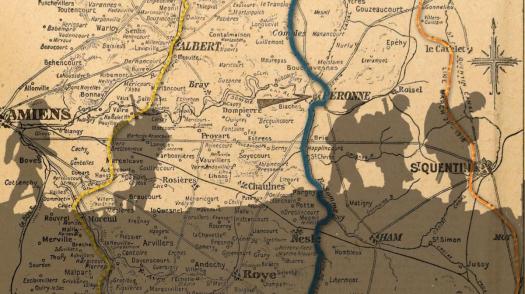
At 11am sharp, one hundred years ago today, a German machine gun crew, hunkered down for days in a muddy dug-out near Le Catelet in northern France, fired a dramatic 1,000 round burst into the gray autumn sky. When they had finished, the men stood up in front of their guns, took off their forage caps, doffed them to the British on the opposite side of the valley, and walked away toward home. With that, the bloodiest, costliest war to that point in history ended.
For most of the crew hope had suffered a mortal blow a long four years earlier. The battle of the Marne River (Hebrew for “rejoice”) had claimed over 500,000 of their countrymen in the second month of the war. The bloody defeat ended any chance of reaching Paris and dashed plans for a quick German victory. But the generals kept on scheming and the men continued to fight, bleed, and, all too often, die. Rivers like the Somme (Gaelic for “tranquility”), that one could walk to in five peaceful minutes, took five months to reach in warfare. Another half a million fellow German soldiers lost their lives in the battle surrounding the normally bucolic river.
August 1914 seemed a lifetime ago. Marching through neutral Belgium the German Army had captured the vital railroad hub at Liège after much bloodshed, but set off for Paris in high spirits. Now, many battles later, pushed back to only 150 miles from the German border, their spirits broken, the machine gun crew guarding the trenches outside of Le Catelet was acutely aware of the barbaric waste of life and of time, and the cost to the nations that the last four years had been. Only Moses’ 40-year trek through the desert with about the same number of men had made worse use of time, some wryly noted as they headed east.
At exactly the same hour, sixty miles away in a luxury railcar parked in a forest near Campiègne, mustachioed old men wearing clean, gold braided and bemedalled uniforms signed papers finally formalizing the outcome of the conflict. The diplomats in waistcoats and the generals in the posh uniforms who had rushed to sabers four years earlier had disastrously dawdled to pick up the pen of peace.
My grandfather’s brother was also part of a machine gun crew in that war. He spent his 17th birthday training to join machine gunners on the eastern front near Angerburg, then part of East Prussia, Germany’s eastern-most province. Like many, he never saw his 18th birthday. My friend Dr. Johann Dünhölter and I visited his final resting place in a wooded cemetery overlooking one of the Masurian lakes, now belonging to Polan
Johann had asked me to accompany him on one last visit to his father’s war grave near Mławka in central Poland. Making a trip of it, we visited towns being restored from a war 75 years ago and ruins which will never be rebuilt, old cemeteries and even older churches, and enjoyed the countryside of former East Prussia scarred forever by a senseless war and the expulsion of its people. It made the history of my family come alive, if only briefly, as I tried to see what was, and imagined what could have been. In subsequent blogs I will try to reveal these Fading Echoes, these Glimpses into a European Past. They will be available on Facebook and at www.fadingechoes.com.
If you would like notification of blogs as they are written, please Facebook message or e-mail me at hreitzug@littlehalley.com and I will add you to my mailing list.

 Fading Echoes