

Deep in thought, consumed by very personal anguish, my friend Johann walks ahead of me up the cobblestoned path to the cemetery. His head is bowed, his hands are clasped behind his back. It is a Calvary-moment for him. There have been more than a few of these since his mother received the tragic news so long ago.
A God-fearing man, a faithful husband, a beloved father of four little children should not have been ripped from life. And yet that is what happened to thirty-six-year-old Karl Dünhölter on that battlefield north of Warsaw in January 1945. Along with 12,478 other German soldiers he has found his final earthly resting place here at the German Military Cemetery near Mławka in central Poland.
Cresting the little hill, the cobblestoned path opens to a massive granite cross surrounded by forty rectangular plinths each engraved with 300 names of deceased soldiers, their birth dates, and the date they fell. Wordlessly Johann points to his father’s name two-thirds of the way down one of the granite memorials.
It is just us and the stones of remembrance here in this sacred space. We stand there mutely in the immense silence of the cemetery. Friedhof it is called in German, translating literally as courtyard of peace. Reverentially the peace of this place is unbroken; no sounds of automobiles, no horns, no music, no lawn mowers, no power tools, no dogs barking, not even the joyful shouts of children at play. Just silence. Restful silence.
An expanse of grass faces the cross and the forty tall memorials. Smaller stone crosses in clusters of three and plaques flush with the ground dot the lawn. A group of maples and birch trees stand diffidently to one side. The still-life panorama is enclosed by a dense wall of fir trees, sealing the sense of solitude.
Presently two birds awake from their noon-siesta and come to the rescue of the stillness. I’m not sure if their spirited chirping sounds are worshipful or war-like in this setting. And then the Polish caretaker of the grounds hobbles up. His house near the entrance of the narrow mile-long dirt track through the woods was the last sign of living civilization.

A war graves commission in Germany manicures and manages the grounds. He gets paid by them to be a presence here. Oblivious to Johann’s need for quiet reflection, or our unpolished Polish skills, he chatters away, finds a vase with artificial flowers to place at the foot of the plinth with Karl Dünhölter’s name on it, unlocks the visitors room showing us historical pictures – and eventually gets a much-appreciated tip from Johann, ever the congenial people-person.
As we say good-bye to the chatty custodian I take a final look at the memorials to the soldiers of two World Wars. Psalm 2 comes to mind. “Why do the nations rage,” it begins. King David, involved in more than his share of war and conflict, penned those timeless words 3,000 years ago.
Driving up from Warsaw took us through the fields where the nations had raged. Red-brick buildings, military trucks, artillery pieces,and other detritus of war pointing to 1945, decaying and rusting in peace in a yard guarded with barbed wire, gave mute testimony to the violent former days. It is the region where Johann’s father had fought his final battle. Driving on a single-track road, brush touching both sides of the car at times, we sought his first resting place. Now overgrown and underused, woods and poverty had staked their claim obscuring most details.

With the aid of the only Polish word I knew, cmentarz, cemetery, a kind man pointed out a makeshift cemetery for soldiers lost in battle in the killing fields of 1945. Johann’s father had been hastily buried here. For 50 years it was his resting place until the German War Graves Commission, the Kriegsgräberfürsorge Amt, moved him to a place of greater honor. Grief came in waves for Johann on this day.
Before we left, the Polish man showed us the pride of his handiwork – jars of honey, Miodu in Polish. Enlarging the smile on the man’s face, kind Johann purchased a large jar, and I doubled my Polish vocabulary.
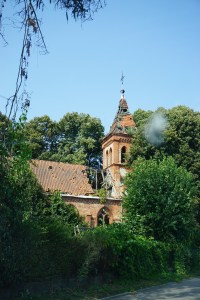
Conquerors and avengers had flaunted their pride-filled ambition and their lethal rage in this region for over two-hundred years. First Napoleon, then the Tsar’s armies, and finally Hitler took their turn. All were eventually chased back, all made round-trips. Boundaries were drawn and re-drawn. Often the boundaries became the cause célèbre of the next conflict. (For more on this select ‘Back Story’ on the menu at the top)
We find the main road to Allenstein (Olsztyn now). It is a wonderful piece of engineering – it pays to belong to the EU. We pass an exit pointing to Nidzica. Neidenburg it was called for over 500 years. We are in old East Prussia. Allenstein is not far from here. My grandfather, his brother who died in combat in 1914, my great-grandfather with his sad story,
my great-grandmother’s priest-brother who played an important role in defusing a brief Russian invasion of Allenstein in 1914, all called this home. Their stories in coming weeks.
 Fading Echoes